
Why Is Spring The Best Time To Get Your Chimney Swept?
If there’s one thing that could put a dampener on your spirits when it comes to renovating your property, it’s a party wall agreement.
A party wall agreement (also known as party wall award if surveyors are appointed) is simply a legal agreement between you and your neighbours which governs any building work that might affect a shared wall, boundary, or outbuilding.
As you can imagine, it can have quite an impact on chimneys.
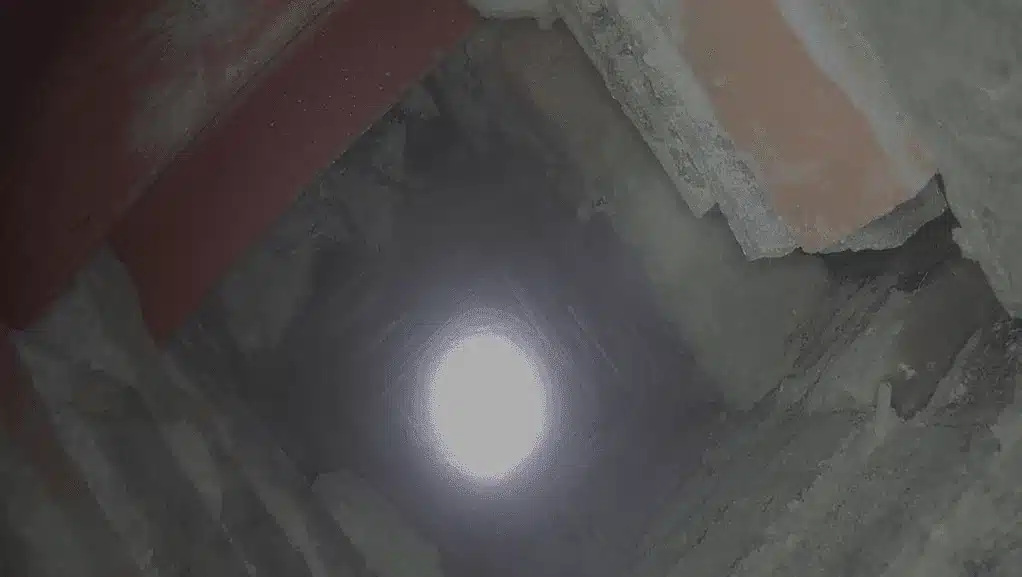
An RSJ has been fitted into the neighbour’s chimney during a loft conversion
How do party wall agreements affect chimneys?
Party wall agreements play a big role during property renovations but, for some reason, the chimney is often forgotten. This is frustrating, but probably because the inside of a flue has been historically difficult to inspect.
Thankfully, that isn’t the case anymore – particularly if you employ the services of the right sweep.
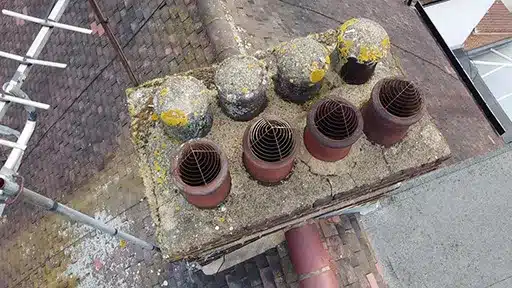
If the chimney rests against a party wall, you’ll find that at least one wall of the flue will be shared. In some cases, it might even overlap. On the stack above, one wall of the flue is shared, each neighbour’s flues are on their own side of the party wall. In the stack below, all the flues are in a row. Although each property will appear to have its own chimney breast, it’s likely the flues overlap in the loft space and the chimney breasts are shared.
Therefore, chimney inspections should always form a crucial part of any party wall agreement – particularly if that party wall is going to be used as a load-bearing wall for a loft conversion, for instance. The same goes if the chimney breast is due to be removed.

Who’s liable for repairs to a chimney on a party wall?
Don’t worry – you’re not alone if you’re pondering this. It’s as natural as it is to wonder who will have to pay for the fence panel that was knocked over during the previous night’s storm. Providing you have the flues checked and tested before any work is carried out, you’ll have a detailed condition report from which to work. This is a vital first step.
The reason is simple: that report (and footage of inside the flue, which you should also be given), will confirm the state of the chimney before the work takes place. Thus, once the work is completed, the same inspection can be carried out, and if there are any changes in condition, the liability can be easily determined.
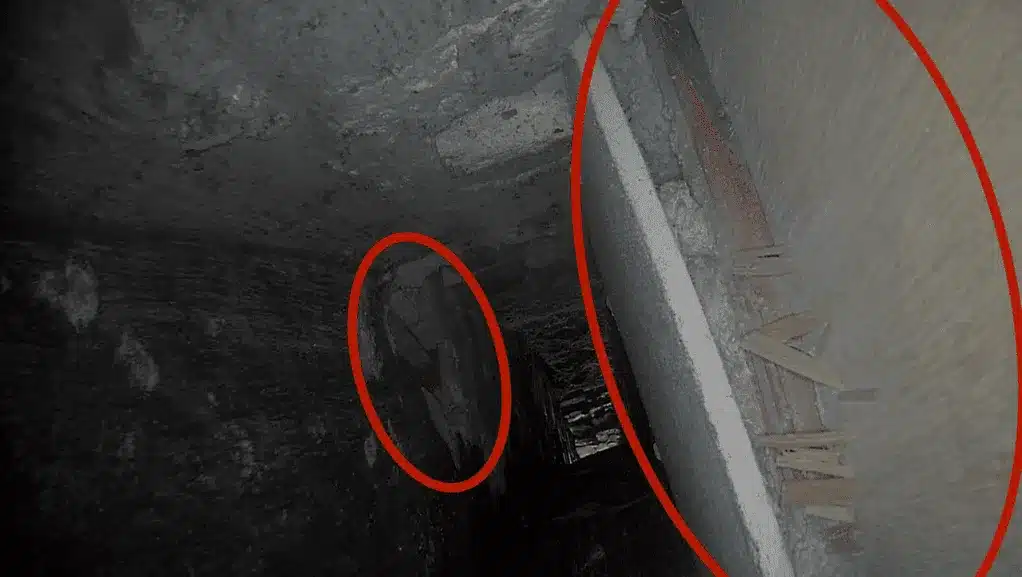
The image below shows a flue that had been previously breached twice by a neighbour next door and an apartment above. You can see chipboard, plasterboard and an RSJ is visible, none of these are appropriate materials for a flue. Without that pre-work inspection, it can be incredibly difficult to determine the cause of any damage that appears later. It’ll require a bit of investment on your part, but you’ll at least have peace of mind, rather than having to deal with any nasty surprises later.
Do you need a party wall agreement to remove a chimney? Yes.
Removing a chimney involves major structural work, and if the chimney stack is shared, this cannot be done without permission being granted from the neighbouring property.
Do party wall agreements apply to chimney stacks, too?
If the stack resides on a party wall – yes.
There are two scenarios to keep in mind:
- if general remedial work is required, each owner will be responsible for the part which is within their curtilage; and
- if the stack needs to be rebuilt, the cost will be joint, because it’s impossible to rebuild only half of it.
As always, both examples above require plenty of cooperation on both sides.